What Factors are Assessed With Drone Testing
Published by:Beyond Sky

 English
Drones today have become marvels of engineering, but how do manufacturers know they will perform reliably and safely in the real world? That’s where drone testing factors come into play. From measuring thrust to assessing flight stability and endurance, thorough UAV testing parameters ensure drones meet quality benchmarks before they ever take flight.
This blog explores essential drone performance testing areas, diving into key factors assessed during drone testing, methods to measure them, and the role advanced test benches play in this ecosystem.
Think of thrust as the muscle power that lifts a drone off the ground. Accurate thrust measurement is critical. Manufacturers test individual motor and propeller combinations on test benches or drone test benches to verify how much lift they generate under different voltages and loads. This helps optimize efficiency and ensures the drone can safely carry its payload.
A drone’s ability to maintain steady flight without wobbling or drifting defines its reliability. Flight stability testing evaluates the drone’s reaction to wind, rapid directional changes, and emergency maneuvers.
Sensors such as IMU and gyroscopes feed data into flight controllers, which software uses to simulate and control responses. Rigorous flight stability tests detect potential control issues before deployment.
Drones carry various payloads, cameras, sensors, or delivery packages. Payload testing measures how additional weight affects flight time, maneuverability, and motor stress.
Understanding payload impact helps tailor drone designs for agriculture, inspection, or delivery use cases while avoiding overloading that could impair performance or safety.
Battery technology largely defines a drone’s flight duration. In endurance testing, drones fly through simulated or real-world missions to gauge usable flight time under different payloads and environmental conditions. This data drives improvements in battery management systems and power distribution boards, enabling longer missions with consistent performance.
To fly well, drones rely on accurate data from GPS modules, IMUs, barometers, and compasses. Calibration tests verify sensor precision and alignment, ensuring the flight controller receives reliable information. Misaligned or drifting sensors increase control errors and degrade flight quality.
Manufacturers expose drones to repeated stress cycles, rapid acceleration, abrupt landings, and motor temperature surges to assess durability. Reliable drones must withstand wear without component failure. In this phase, real-time telemetry logs data on voltage, current, temperature, and motor rotation (RPM) to monitor system health.
Environmental and safety testing pushes drones beyond lab comfort zones. This factor assesses how well UAVs perform under varying weather and electromagnetic conditions. Drones are placed inside controlled environments that simulate high-altitude pressure, extreme humidity, rainfall, or gusty winds to see how resilient the system is.
These assessments identify environmental thresholds for safe operation, helping manufacturers classify drones according to IP (Ingress Protection) ratings and operational altitude limits. Another aspect involves EMI (Electromagnetic Interference) testing, which checks if onboard electronics maintain signal fidelity when exposed to industrial radio frequencies or radar systems.
Equally important is safety testing, focusing on fail-safe design and emergency mechanisms. Engineers simulate sensor failures, low-battery triggers, GPS loss, or motor stalling to study how a UAV behaves when something goes wrong mid-air.
Reliable drones must automatically switch to stabilization or return-to-home mode instead of crashing. Safety testing directly informs airworthiness certification required under DGCA, FAA, or ASTM UAV standards.
Including environmental and fail-safe considerations ensures that drones are not only efficient but dependable in unpredictable real-world conditions.
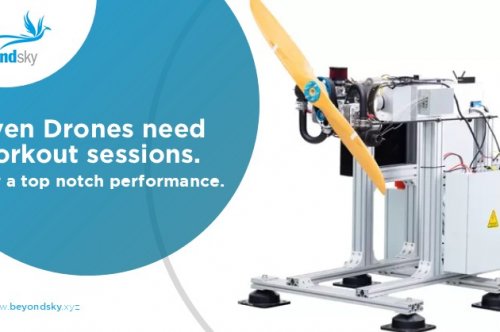
Testing drones efficiently demands specialized equipment. This is where drone test benches and thrust stands come in, dedicated platforms designed to simulate aerodynamic loads on motors and propulsion systems while measuring critical parameters.
Beyond Sky proudly partners with WingFlying, a pioneer in drone propulsion testing since 2017. Their advanced thrust stands and test benches offer everything from small UAV propulsion analysis to heavyweight engine testing.
Using WingFlying’s test equipment allows developers and manufacturers to detect subtle motor-propeller inefficiencies, fine-tune controls, and validate endurance , all on the ground, before flight verification.
Beyond Sky proudly partners with Dynotis, is a precision testbench that supports your engineering decisions by enabling detailed comparisons of various motor–propeller combinations for specific missions. We also design custom-built test benches, tailored to match the exact specifications and unique requirements of your specialized projects.
Skipping or skimping on drone performance testing risks failures mid-mission, crashes, safety hazards, and costly recalls. Reliable drone operations require forward-looking testing that is thorough and precise.
UAV testing parameters now embrace multi-disciplinary approaches combining mechanics, electronics, software, and environmental factors for comprehensive assessment.
Drone testing factors cover a complex array of performance areas, thrust, stability, payload handling, endurance, calibration, and system reliability, all essential for top-quality UAVs. Test benches and thrust stands like those from WingFlying empower developers to precisely measure and optimize drones’ propulsion and flight capabilities.
Through robust drone quality assurance processes, UAVs are evolving into safer, more efficient, and mission-ready aircraft fit for commercial, industrial, and research applications. The right test infrastructure bridges the gap between theoretical design and real-world success, making drone flights not just possible, but dependable.
Drone testing verifies that UAVs perform safely and reliably under all flight conditions. It helps manufacturers identify issues in propulsion, stability, sensors, endurance, and safety systems before market release, ensuring compliance with aviation standards like FAA, ASTM, or DGCA.
Core testing parameters include thrust, flight stability, payload capacity, endurance, sensor calibration, and overall system reliability. Developers simulate operational missions and environmental impacts to validate controllability and system integrity.
Thrust testing measures lift generated by motor-propeller combinations, guiding propulsion optimization. Stability tests monitor drone behavior in turbulence or quick maneuvers, ensuring it holds altitude and direction under stress conditions.
Manufacturers use test benches and thrust stands to measure torque, thrust, current, and RPM. Companies like WingFlying and Dynotis provide advanced systems simulating flight loads for small to heavy UAVs, enabling precise ground testing before real-world deployment.
Endurance testing indicates flight time under varying payloads, temperatures, and wind speeds. Results help refine battery management, improve motor efficiency, and balance power consumption during extended missions.
Drones undergo simulated weather exposure, humidity, temperature extremes, and wind to evaluate durability. Safety testing adds fault simulations, such as GPS loss or low-battery failsafes, to confirm the UAV’s ability to recover without damage.