The Complete Guide to Drone Thrust Stands and Testing Tools
Published by:Beyond Sky

 English
Modern drones are everywhere, from aerial mapping and delivery to agriculture, cinematography, and defense. As this industry evolves, the demand for reliability, longevity, and precision rises, too. Whether building micro-UAVs or large multi-rotor craft, every drone must deliver optimal performance and uncompromised safety.
The heart of these capabilities lies in the propulsion system, where motors and propellers dictate speed, agility, endurance, and payload. Testing is not just recommended, it is mission-critical.
Drones operate in varied and sometimes hostile environments. Suboptimal propulsion tuning leads to wasted battery, excess heat, instability, and unpredictable failure. For commercial fleets, a failed drone means wasted mission costs and potentially lost data or damage. In defense or medical applications, reliability is non-negotiable.
Rigorous testing using specialized drone test tools, like drone thrust stands and drone testing equipment, shifts the game from guesswork to precision, ensuring every motor, propeller, and engine meets mission requirements.
Motors and propellers interact in complex ways, and many factors influence the results.
Here are some of the main hurdles that teams face during UAV drone testing:
These challenges make it clear that testing requires specialized tools. That’s where drone thrust stands come in — offering a structured, safe, and data-rich way to measure performance.
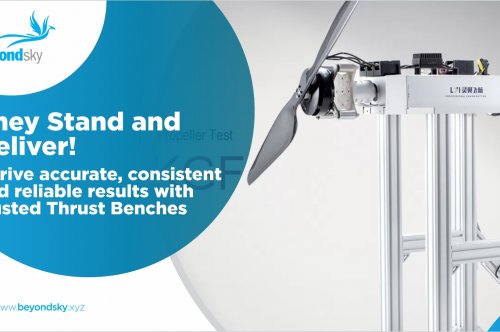
A drone thrust stand is essentially a Drone test bench built to measure propulsion performance with high precision. It tells you exactly how much thrust a motor-propeller setup produces, how much torque it generates, and how much power it consumes. By combining these readings, developers can make smarter design decisions.
You’ll find several types:
Unlike basic rigs, these drone test tools come with calibrated sensors, digital displays, and software interfaces. They let you visualize performance in real-time, run automated test sequences, and store data for analysis.
The biggest advantage of a thrust stand is precision. It measures thrust and torque down to fine increments, giving engineers accurate insights into how a motor performs under different power levels. This accuracy ensures you’re not relying on rough estimates but on verifiable data.
Thrust stands record voltage, current, and thrust simultaneously. This lets you calculate how efficiently your system converts electrical power into lift. The result? Better energy management and longer flight times.
Testing on a drone test bench keeps everything secure. The motor and propeller are firmly mounted, so even full-throttle tests happen safely. This is crucial for powerful motors that can’t be tested in a freehand manner.
Human error can throw off measurements in manual testing. Thrust stands maintain stable conditions, giving you consistent data every time. Repeatable results mean you can compare tests fairly and track improvements accurately.
Modern thrust stands come with software that logs all readings automatically. You get detailed performance graphs showing how thrust, torque, and power change over time. This data makes it easy to spot patterns or performance issues.
Whether you’re testing micro drones or heavy-lift UAVs, there’s a thrust stand designed for your load range. Specialized options like Drone Coaxial Thrust Stands even let you evaluate counter-rotating systems used in advanced designs.
Finding the Right Power-to-Weight Ratio
Thrust stands feature in every major UAV development workflow—from R&D labs to mass production lines, and educational settings. Some core applications include:
Thrust stands enable testing beyond single motors—supporting coaxial systems, large-format engines, hybrid powertrains, and vertical takeoff and landing (VTOL) craft. Advanced test systems today integrate AI-driven analytics and modular architectures for multi-rotor, multi-motor, or engine test stands. This makes them adaptable, scalable, and future-ready.
Beyond Sky is proud to partner with WingFlying, a trusted innovator in drone propulsion testing since 2017. WingFlying’s full range of advanced thrust stands and test benches are now available directly through Beyond Sky’s global B2B marketplace, giving UAV developers, OEMs, educators, and researchers seamless access to precision testing solutions.
WingFlying’s products include high-precision load cells, temperature compensation, and integrated software that provide real-time monitoring of thrust, torque, voltage, current, RPM, and efficiency. Their test equipment supports manual and automatic modes and is designed for all drone sizes—from medium-sized UAV propulsion systems with up to 10 kg thrust capacity (LY-10KGF) to high-performance engines with thrust capabilities up to 150 kg (WF EN 50 Engine Test Bench).
Key features include:
In short, WingFlying thrust stands bridge the gap between theoretical design and field success, making high-level drone performance accessible to all.
An advanced testing tool to measure and record thrust, torque, voltage, current, RPM, and efficiency of medium-sized propulsion systems. Perfect for detailed motor and propeller performance analysis.
Find more info: LY 10KGF Thrust Stand
Designed to test dual coaxial motors and propellers simultaneously, or single units, supporting up to 30 kg thrust and 40-inch propellers. Ideal for complex system evaluations.
Find more info: WF CO 30 KGF Coaxial Thrust Stand
Supports UAV engines up to 150 kg thrust and 60-inch propellers. Perfect for high-performance engine testing and propulsion system optimization.
Find more info: WF EN 50 Engine Test Bench
All WingFlying products are now available on Beyond Sky, your go-to drone marketplace.
A thrust stand is a specialized test bench that measures a drone motor and propeller’s thrust, torque, and power consumption. It provides precise data to optimize propulsion performance, ensuring better flight stability, efficiency, and safety.
Thrust stands eliminate errors common in manual setups by securely mounting components and using calibrated sensors. They deliver consistent, repeatable, and detailed real-time data, reducing guesswork and helping fine-tune designs.
Key benefits include trusted measurement accuracy, real-time power efficiency data, safer testing environments, consistent results, comprehensive data logging, and adaptability for all drone sizes and propulsion types.
By analyzing power consumption at different throttle levels, thrust stands identify the most efficient motor settings. This enables tuning for optimal performance, extending battery life without sacrificing flight capability.
Yes, there are thrust stands designed for coaxial dual-propeller setups, hybrid powertrains, and large engines, making them suitable for modern multirotor and VTOL drones.
Thrust stands are essential in R&D labs, OEM manufacturing, defense, commercial fleet testing, academic research, and among hobbyists aiming to maximize performance and reliability.
WingFlying thrust stands available through Beyond Sky offer models like the LY 10K GF for medium UAVs, WF CO 30 KGF coaxial stands, and WF EN 50 Engine Test Bench for high-thrust UAV engines—all with integrated software for precise real-time analysis.