How Far do Drones Fly Explore Flight Range and Real-World Limits in 2025

Published by:Beyond Sky
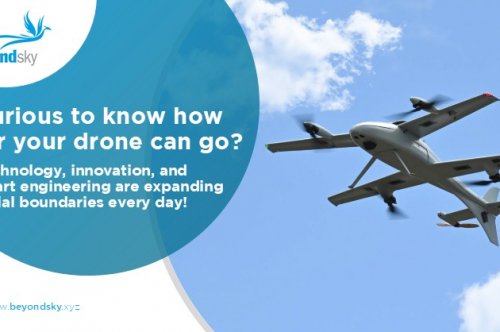
Drone flying over showcasing long-range UAV flight in 2025

A common question that occurs o both new and experienced drone operators alike is: how far can their drones actually fly? No longer toys for hobbyists, drones today are powerful tools used in farming, construction, delivery, surveillance, and even defense. Understanding drone flight range is important to pick the right drone, plan safe missions, and make the most of your UAV technology.

Let’s look at what affects the distance drones can travel, and the average flight ranges of different drone types such as multirotor, fixedwing, VTOL, and military-grade drones.

We will also discuss legal restrictions, share tips on safely extending your drone's flight distance, and explore how long-range drones are being used in today's world.

Factors That Affect Drone Flight Distance

  1. Battery Capacity and Power Consumption: A drone’s battery holds the energy that keeps it airborne. Larger batteries often support longer flights, but they also weigh more. This extra weight can cancel out gains in energy. Efficiency depends on how well the drone balances capacity with total mass. Motors, propellers, and controllers also draw energy at different rates. A design that conserves power under load will travel farther.
  2. Drone Design Type: Different drone designs perform differently:
    1. Multi-Rotor Drones hover with precision and stability but drain energy fast because each rotor works to stay aloft.
    2. Fixed-Wing Drones glide through the air, using lift instead of thrust to stay airborne. This allows them to cover more distance on the same power.
    3. VTOL Drones combine vertical lift with efficient forward flight. They can take off from tight spaces but still travel longer routes once airborne.
  3. Flight Speed and Patterns: Every movement uses energy. Fast climbs, sharp turns, and long periods of hovering shorten flight time. Smooth, consistent flight paths allow motors to work efficiently and stretch distance.
  4. Payload and Accessories: Every gram matters. Cameras, sensors, or delivery cargo increase power demand. The more weight you carry, the shorter your trip. Planning means balancing what you need onboard with how far you need to go.
  5. Weather and Conditions: Strong winds, heat, and cold affect performance. Headwinds slow progress and force motors to work harder. Cold weather reduces battery output. Even humidity can alter lift and drag. Calm skies and mild temperatures give the best results.
  6. Control and Communication Range: A drone must stay in touch with its operator or system. Most models rely on radio signals, which weaken with distance or interference. Advanced systems use boosted antennas or satellite links to maintain command far from the pilot.
  7. Legal and Regulatory Limits: Rules often define practical range more than technology. Many countries restrict flights beyond visual line of sight (VLOS) or near restricted zones. Range potential means little if flight plans break regulations.

Average Drone Flight Ranges in 2025

With new batteries, efficient motors, and better designs, drones fly farther than ever before. Still, performance depends on category and purpose.

MultiRotor Drones

The most common drones for photography, mapping, and inspection, multi-rotors balance stability with range. Modern models typically travel 3 to 10 kilometers on one charge. The DJI Mavic 3 series, for example, can exceed 9 kilometers in ideal conditions. Multirotor shine in control and precision but trade off endurance.

Fixed Wing Drones

Built like miniature airplanes, Best Long Range Fixed Wing Drone glide over large areas efficiently. In 2025, many achieve 40 to 150 kilometers of range. The senseFly eBee X is one example, offering 90 minutes of flight and coverage for wide regions. These drones thrive in agriculture, surveying, and environmental work.

VTOL Drones

Vertical Takeoff and Landing (VTOL) drones merge fixed-wing range with multi-rotor flexibility. They can take off from small areas, then transition into energy-efficient flight. VTOL drones average 20 to 120 kilometers, depending on configuration and payload.

Military-Grade Drones

Defense systems set the upper limit. Tactical UAVs like the RQ-11 Raven operate across dozens of kilometers, while larger aircraft such as the MQ-9 Reaper fly thousands. Long endurance comes from large fuel reserves, advanced engines, and satellite control links.

Drone Type

Typical Range (km)

Average Flight Time

Best Use Case

Example Model

Multi-Rotor Drones

3–10

30–45 min

Photography, Inspection

DJI Mavic 3

Fixed-Wing Drones

40–150

60–120 min

Mapping, Agriculture

eBee X

VTOL Drones

20–120

60–150 min

Infrastructure, BVLOS

Quantum Trinity

Military-Grade Drones

100–1000+

8–30 hrs

Reconnaissance, Defense

MQ-9 Reaper

Advanced Technology Behind Flight Range

Understanding drone range means exploring the systems that power and propel it. Each component battery, motor, and communication link plays a role in total endurance.

Battery Innovation

Modern drones run on energy-dense cells built for lightweight power. In 2025, several battery types lead the market:

  • Lithium-Ion (Li-ion) batteries deliver 250–300 Wh/kg, enabling 30–45 minute flights for multi-rotors.
  • Semi-Solid State Batteries use gel electrolytes for stability and faster charging, reaching 80% charge in 30 minutes.
  • Solid-State Batteries exceed 400 Wh/kg, doubling flight time for long-range systems.
  • Hydrogen Fuel Cells push endurance beyond 8 hours, ideal for mapping and surveillance.

A strong Battery Management System (BMS) ensures cells stay balanced, monitored, and protected during flight.

Propulsion Efficiency

Motors convert stored energy into thrust. The best designs operate at 85–95% efficiency, minimizing waste. Brushless DC motors paired with optimized carbon fiber propellers deliver strong lift with low power draw. Proper pairing between motor and propeller increases endurance by up to 20%.

Aerodynamic propeller designs reduce drag and improve thrust-per-watt performance. Testing on thrust stands shows that small changes in pitch and blade width can extend flight range noticeably.

Communication Range

For long missions, stable communication is essential. Each frequency band has its own reach and purpose:

  • 2.4 GHz: 3–5 km, good obstacle handling
  • 900 MHz: Up to 60 km, ideal for BVLOS
  • 5.8 GHz: High data rates, shorter reach
  • 433 MHz: Long-range telemetry

Professional systems split data, video, and control signals across different frequencies to avoid congestion. Satellite links in BVLOS or defense drones extend coverage beyond line of sight.

What are the Legal Flight Limits

Technology alone cannot define how far a drone can go. Regulations exist to protect airspace, property, and safety.

  1. Visual Line of Sight (VLOS): In most regions, pilots must keep drones visible to the naked eye. That usually limits range to a few kilometers, though clear skies and open terrain can stretch visibility.
  2. Beyond Visual Line of Sight (BVLOS): Longer missions need special permissions and certified systems. BVLOS operations depend on tracking tools, detect-and-avoid sensors, and flight planning software to ensure safety.
  3. Airspace Restrictions: Many zones remain off-limits. Airports, military areas, and government sites often have no-fly rules. Some countries also ban flights over crowds or highways.
  4. Altitude Rules: Standard flight ceilings sit around 120 meters (400 feet) to prevent conflicts with manned aircraft. Higher altitudes require clearance and coordination with aviation bodies.

How to Safely Extend Drone Flight Distance

Operators can improve range through smart planning and upgrades. Safe endurance comes from efficiency, not risk.

  1. Plan with BVLOS software to chart routes, check airspace, and monitor performance.
  2. Lighten payloads by removing non-essential gear.
  3. Use aerodynamic designs and steady cruise speeds instead of hovering.
  4. Upgrade to high-capacity or solid-state batteries for more energy per gram.
  5. Check weather to avoid strong winds or cold temperatures.
  6. Use advanced antennas or signal boosters for stronger control links.
  7. Enable fail-safes like return-to-home for low battery or signal loss.

Each improvement adds range without breaking rules or risking safety.

Techniques to Optimize Flight Range

More advanced strategies like these can unlock even greater performance for commercial or research missions.

  • Aerodynamic Refinement: Smooth frames and balanced weight reduce Proper center of gravity keeps the drone stable and efficient. Carbon fiber materials offer strength with minimal mass.
  • Smart Power Management: Modern systems track every cell’s health. Smart batteries display accurate remaining flight time and optimize discharge rates. Some hybrid designs mix batteries with fuel engines, increasing endurance twofold.
  • Adaptive Flight Algorithms: AI-driven control systems learn from conditions in real time. They fine-tune speed, altitude, and climb rates to save energy. Terrain-following tools keep flight levels stable across uneven landscapes.
  • Communication Enhancements: High-gain antennas and mesh networks extend connectivity. Fleets can act as relays, passing signals across long routes for coordinated missions.

Real-World Applications of Long-Range Drones

Longer flight distances open new possibilities across industries.

  • Agriculture: Fixed-wing and VTOL drones map large fields for soil, crop, and irrigation analysis. Long range cuts costs and saves time across vast farmland.
  • Infrastructure Inspection: Power lines, pipelines, and highways stretch for miles. Long-range drones inspect assets without moving the ground crew.
  • Search and Rescue: In emergencies, drones scan wide regions fast, guiding rescuers toward signs of life or hazards.
  • Environmental Science: Researchers track forests, rivers, and wildlife over extended areas, gathering consistent data across seasons.
  • Construction and Surveying: Long-range drones deliver aerial surveys for large projects, comparing progress against digital plans.
  • Delivery Networks: Extended range makes parcel delivery viable across suburbs and rural zones, improving logistics.
  • Military and Security: Defense agencies rely on endurance UAVs for border patrol, reconnaissance, and monitoring, keeping crews safe on the ground.

Conclusion

So, how far can drones fly? The answer depends on purpose, design, and responsibility.

Multi-rotor drones balance control with short to medium range. Fixed-wing drones soar across long distances with efficiency. VTOL models blend flexibility and reach. Military-grade UAVs push limits with advanced systems and satellite control.

Battery breakthroughs, efficient motors, and intelligent software continue to expand possibilities. But success in long-range operations comes from knowledge, planning, and adherence to the law.

FAQs

1. What is the typical flight range for consumer drones?

Most multi-rotor consumer drones fly 3-10 kilometers on one battery. High-end models like DJI Mavic 3 can reach 9+ kilometers in ideal conditions.

2. Which type of drone has the longest flight range?

Fixed-wing drones achieve the longest range, typically 40-150 kilometers, while VTOL drones offer 20-120 kilometers. Military drones can fly thousands of kilometers.

3. What factors limit how far a drone can fly?

Battery capacity, drone design, payload weight, weather conditions, communication range, and legal regulations all affect maximum flight distance.

4. How do weather conditions affect drone flight range?

Strong winds, cold temperatures, and high humidity reduce flight range by increasing power consumption and decreasing battery efficiency.

5. What are the legal limits for drone flight distance?

Most countries require Visual Line of Sight (VLOS), limiting range to a few kilometers. Beyond Visual Line of Sight (BVLOS) operations require special permits.

6. How can I safely extend my drone's flight range?

Use efficient flight patterns, reduce payload weight, upgrade to high-capacity batteries, plan routes with BVLOS software, and avoid adverse weather.

7. What battery technologies enable longer drone flights?

Solid-state batteries (400+ Wh/kg), hydrogen fuel cells (8+ hours), and advanced lithium-ion systems significantly extend flight endurance compared to standard batteries.

8. Which industries benefit most from long-range drone capabilities?

Agriculture, infrastructure inspection, search and rescue, environmental monitoring, surveying, delivery services, and defense operations rely on extended flight ranges.
Was this article helpful?