Drone Deliveries: Transforming Retail & Logistics
Published by:Beyond Sky
 English
It’s hard to talk about the future of retail without mentioning drones. Consumers expect speed now, same day, sometimes same hour, and that pressure is pushing retailers and logistics companies to rethink how they move goods.
Drones aren’t some distant experiment anymore. They’re right up on the roof, and are starting to make a serious impact, especially in what’s known as last-mile delivery.
You can think of drone delivery as the next big shift after automation in warehouses. The same way robots changed fulfillment, drones are beginning to change how products get to your doorstep. It’s not hype, it’s just efficiency evolving at speed.
The real strength of retail drone delivery is in cutting time. Traditional delivery models still depend on traffic, road networks, and human schedules. Drones don’t. They fly the most direct route between two points and skip the ground-level congestion. A delivery that used to take a few hours can now take fifteen minutes.
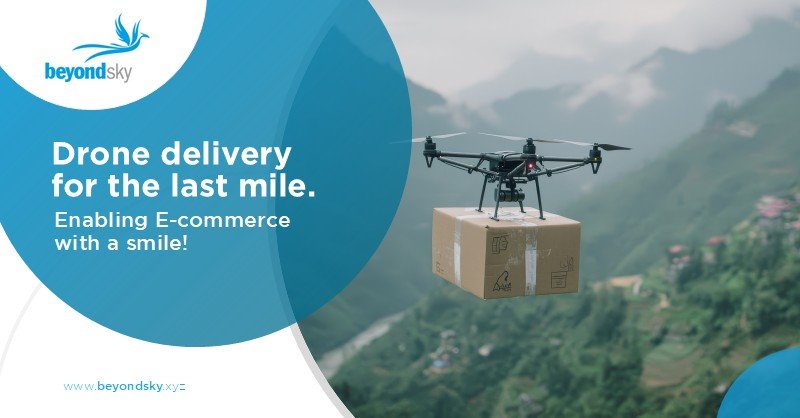
In logistics, it’s not only about speed. It’s about reach and adaptability. Drones can handle places that trucks or bikes can’t. Think mountainous areas, islands, or rural regions with poor infrastructure. They can also operate in tight urban environments where parking or street access is a nightmare.
Drone delivery isn’t just about novelty, it’s about performance.
For companies that deal with small or time-sensitive goods like food, medicine, and e-commerce parcels, these advantages are hard to ignore.
Most of the buzz sits around last-mile delivery, and for good reason. That final leg from warehouse to doorstep is the slowest, most expensive, and most complex part of logistics. Drones cut straight through it.
Some big brands are already piloting same-hour drone delivery programs. You order online, and a drone leaves the nearest micro-warehouse to drop it on your porch or designated landing pad.
On large industrial sites, drones carry small parts or samples between sections. It saves human time and keeps production lines moving.
Drones deliver blood samples, vaccines, or critical supplies to rural or emergency zones. In some countries, this is already saving lives.
Hot meals and groceries delivered without traffic or long waits. It’s still early, but the potential is clear.
These aren’t just trials anymore. They’re active programs in real supply chains, backed by data showing faster turnaround and reduced costs.
Now, it’s easy to get carried away by the potential, but running a drone delivery operation isn’t simple. There’s a long list of challenges, some technical, some regulatory.
The progress is steady, but the rollout will take time. The companies getting this right are the ones investing not just in hardware but also in systems like airspace coordination, ground infrastructure, and public engagement.
The next few years will probably decide how fast drone delivery goes mainstream. The technology side is catching up fast. Batteries are improving, AI flight control is getting smarter, and BVLOS (Beyond Visual Line of Sight) operations are being approved more often.
We’re also seeing hybrid models emerge. Picture this: a delivery van drives to a neighborhood hub, and from there, small drones handle individual drop-offs. It’s a blend of old and new that keeps costs in check while adding flexibility.
Behind all this, the software layer is evolving too. Fleet management platforms now handle dozens or hundreds of drones, routing them in real time, managing battery swaps, and tracking weather conditions. It’s logistics intelligence in the cloud.
By 2025, drone delivery won’t just be a futuristic headline. It will be part of standard delivery networks, especially in urban and suburban markets.
Drone delivery needs more than drones. It needs structure, compliance, and trust. That’s where BeyondSky adds value.
The platform helps manufacturers, sellers, and operators verify that their drone systems meet local and international standards. It connects verified suppliers with logistics companies and retailers looking to integrate drones into their delivery systems.
By managing documentation, safety compliance, and technical certifications, BeyondSky simplifies what would otherwise be a messy, bureaucratic process. It helps businesses focus on building reliable drone operations instead of getting lost in paperwork.
That kind of ecosystem support is what’s turning drone logistics from a collection of pilots into a functioning global industry.