VTOL drones hold a special place in the evolution of unmanned aerial vehicles. Why? Because they blend two key drone capabilities - vertical take-off and landing, like what multirotors do, and the cruising efficiency typical of fixed-wing aircraft.
This amazing combination opens up new possibilities, especially in areas where space is tight but distance and endurance matter. It’s no surprise that VTOL and electric VTOL (eVTOL) drones are making waves in fields from aerial mapping to emergency response and delivery logistics.
This guide explains what VTOL drones are, how they work, the engineering behind them, their advantages, and why industries worldwide are adopting them as the new standard for professional UAV missions.
What Is a VTOL Drone?
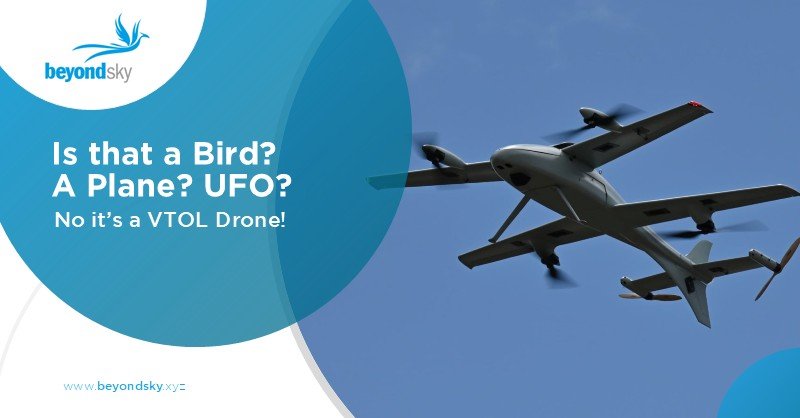
A VTOL drone is an unmanned aircraft capable of Vertical Take-Off and Landing while also transitioning into efficient fixed-wing forward flight. It combines the strengths of two established UAV types:
- Multirotor systems (precise hovering, takeoff, and landing)
- Fixed-wing aircraft (long range, aerodynamic efficiency, endurance)
Unlike traditional fixed-wing drones, VTOL drones do not require a runway. Unlike multirotors, they are not limited by short flight times or battery inefficiency. This hybrid architecture is precisely why VTOL drones are now preferred for large-area mapping, BVLOS inspections, delivery operations, and long-distance surveillance.
How VTOL Drones Work: The Four-Phase Flight Model
Every VTOL drone, regardless of its design or brand, follows a similar four-phase operational pattern. This predictable structure is one reason they are favored for automated missions.
Vertical Take-Off (Multirotor Mode)
In the first stage, the drone uses dedicated lift motors—similar to a quadcopter—to rise vertically.
Why this matters:
- Can operate from small clearings, rooftops, fields, or uneven terrain.
- Eliminates the need for runway infrastructure.
- Keeps high-value payloads (LiDAR, EO/IR, multispectral sensors) safe during liftoff.
This mode provides stability and precise control, especially valuable in industrial and defense operations.
Transition Mode (Lift to Wing-Based Flight)
Transition is the most technically complex part of VTOL flight. The aircraft gradually tilts forward and increases airspeed until the wings generate sufficient lift.
During transition, the flight controller actively manages:
- Motor RPM changes
- Attitude correction
- Airspeed tracking
- Angle-of-attack adjustments
- Stall-prevention algorithms
Modern VTOLs rely on IMUs, GNSS modules, accelerometers, gyroscopes, and airspeed sensors to ensure a smooth, safe transition.
Fixed-Wing Cruise (Long-Range Flight)
Once in forward flight, wings take over most of the lifting work. This significantly reduces battery consumption.
Benefits of fixed-wing cruise:
- Covers hundreds of hectares in a single flight
- Flies longer distances at higher speeds
- Uses less power than hover-based flight
- Maintains stable flight paths for mapping or corridor inspections
Cruise mode is what makes VTOLs ideal for BVLOS and long-range missions.
Vertical Landing
The drone transitions back into multirotor mode and descends vertically.
Why it’s important:
- Eliminates crash risks associated with fixed-wing landings
- Avoids damage to fragile sensors
- Allows safe retrieval in tight or rugged environments
This repeatable landing capability makes VTOLs reliable for automation, fleet operations, and remote deployment.
Core Technologies Inside a VTOL Drone
High-performing VTOL drones depend on multiple integrated technologies working seamlessly:
- Lift Rotors / Multirotor Propulsion: Provide vertical thrust during takeoff and landing.
- Fixed Wings: Deliver aerodynamic efficiency and longer endurance during cruise.
- Flight Controller (PX4, Ardupilot, or proprietary): Coordinates transitions, stabilization, GPS navigation, and failsafes.
- GNSS + RTK/PPK Modules: Enable high-accuracy survey missions and precise positioning.
- IMU (Inertial Measurement Unit): Maintains balance and attitude stability.
- Airspeed Sensor: Critical for safe transition and stall prevention.
- C2 Communication System: Handles command and control (radio, LTE/5G, or satellite link).
- High-Energy Battery or Hybrid Engine: Electric for quiet/short missions; hybrid for multi-hour operations.
These technologies collectively allow VTOL drones to perform missions that traditional UAVs cannot complete efficiently.
Types of VTOL Drones
VTOL drones come in several architectures. Each has strengths depending on mission requirements.
1. Tilt-Rotor VTOL
Rotors tilt forward after takeoff to enable fixed-wing flight.
Pros: Fast transition, efficient forward flight
Cons: Mechanically complex
2. Tilt-Wing VTOL
Entire wing rotates, changing orientation from vertical to horizontal.
Pros: High lift and smoother transitions
Cons: More expensive to engineer
3. QuadPlane VTOL (Most Common in Industry)
A fixed-wing aircraft with additional vertical lift motors.
Pros: Simple, reliable, widely used for mapping and BVLOS
Cons: Slightly heavier due to additional motors
4. Electric VTOL (eVTOL)
Battery-powered, clean, and quiet.
Ideal for: Surveying, environment monitoring, short-range missions.
5. Hybrid VTOL
Uses electric motors for lift and a fuel engine for cruise.
Ideal for: Long-endurance missions (2–8 hours or more).
Industry Applications of VTOL Drones
VTOL UAVs are widely used across civilian, commercial, and government sectors.
1. Mapping & Surveying
VTOLs excel at covering large areas and collecting consistent aerial data. They support:
- Land surveys
- Construction monitoring
- LiDAR scanning
- Photogrammetry
- Corridor mapping (roads, pipelines, railways)
Their combined hover + cruise capabilities allow both high-resolution data capture and efficient coverage.
2. BVLOS Operations
Beyond Visual Line of Sight missions require long-range endurance VTOLs are ideal for:
- Transmission line inspections
- Oil and gas pipeline monitoring
- Railway network assessments
- Coastal and border surveillance
Longer flight times reduce operational cost and improve mission reliability.
3. Delivery and Logistics
VTOLs support:
- Medical delivery
- Rural supply routes
- Emergency supply chains
- Mid-mile logistics
They offer fixed-wing efficiency for long legs and vertical landing for precise drops.
4. Defense and Security
VTOL drones provide critical capabilities including:
- ISR (Intelligence, Surveillance & Reconnaissance)
- EO/IR target tracking
- Border patrol
- Maritime surveillance
- Search & rescue
- Night-time monitoring
Their endurance and stable hover make them highly effective for tactical missions.
5. Environmental & Agricultural Monitoring
VTOL drones enhance monitoring of:
- Forests
- Coastlines
- Wildlife habitats
- Agricultural fields
- Disaster zones
They provide consistent coverage while maintaining the ability to hover for detailed observation.
Challenges of VTOL Drones
Even though they offer industry-leading performance, VTOL drones face certain limitations:
- Higher cost compared to multirotors
- More complex transitions requiring advanced control algorithms
- Weather sensitivity, especially during transition phases
- Regulatory requirements for BVLOS missions
- Heavier airframes due to dual-propulsion systems
These challenges are reducing over time as manufacturing matures and regulations evolve.
Future of VTOL Technology
VTOL innovation is accelerating due to emerging technologies:
- AI-Assisted Stabilization and Autonomy: Smarter controllers for safer transitions and automated missions.
- Hydrogen Fuel Cell VTOLs: Multi-hour endurance for large-scale operations.
- Fully Autonomous Cargo Networks: Drone corridors connecting cities, ports, and remote regions.
- Drone-in-a-Box VTOL Systems: Automated launch, recharge, and landing stations.
- Swarm-Capable VTOL Systems: Coordinated fleets for defense and emergency response.
How BeyondSky Supports VTOL Buyers, Builders, and Operators
BeyondSky is the world’s first global B2B marketplace dedicated to drones and unmanned systems. It helps enterprises discover:
- Industrial VTOL UAVs
- BVLOS-compliant autopilot systems
- EO/IR, LiDAR, multispectral sensors
- Navigation and GNSS modules
- Ground control stations
- Long-endurance batteries and propulsion systems
- Verified OEMs and global manufacturers
Buyers can compare multiple VTOL platforms, evaluate specifications, connect with suppliers, and source components all in one place.
Explore VTOL Drones on BeyondSky
- Range: Up to 200 km of range and 2 hours of autonomy
- Payload: Upto 5 kg
- MTOW: 25 kg
- BVLOS and Autonomous: Flight Ready
- Applications: Medical Drone Delivery, Search & Rescue, Inspection, Surveillance
- Weight (MTOW): 8.2 kg
- Flight Time: 80 min
- RTK/PPK: Survey grade accuracy
- Payload: Multi Spectral, Thermal Imaging, RGB Mapping Camera, Night Payload
- Cruise Speed: 100 kph
ADARNA V2 by TSAW Drones
Adarna v2 mini
- Payload Upto 2 kg
- Range: 80 km
- Endurance: 60 min
- Maximum Height: 4000 m
Adarna V2
- Payload: Upto 8 kg
- Range: 120 km
- Endurance: 90 Min
- Maximum Height: 4000 m
MTOW: 65Kg
Payload: 20Kg
Range: 200Km
Powertrain: Hybrid- HC Generator
FAQs
- What does VTOL stand for?
VTOL means Vertical Take-Off and Landing. VTOL drones can take off and land vertically like helicopters but fly horizontally like airplanes for efficient long-distance travel.
- How do VTOL drones work?
They use rotors or fans that point downward for vertical lift during takeoff and landing, then transition to fixed-wing flight for cruising. This involves tilting rotors or switching motors to provide forward thrust.
- What are the main types of VTOL drone designs?
Common architectures include tilt-rotor (rotors tilt), tilt-wing (wings tilt), and lift-and-cruise (separate motors for vertical lift and cruise).
- Why choose VTOL over other drones?
VTOL combines the hover and vertical lift of multirotors with the range and endurance of fixed-wing drones, ideal for missions in confined spaces needing long flights.
- What powers VTOL drones?
Most use electric lithium-ion or lithium-polymer batteries. Emerging options include hybrids and hydrogen fuel cells for longer endurance.
- What challenges exist for VTOL drones?
Transitioning smoothly between vertical and horizontal flight is complex. Battery life limits endurance, regulations lag for new flight modes, and public acceptance varies.