Drone Motors Explained: Types, Specifications, and Applications You Should Know
Published by:Beyond Sky

 English
When you think of what actually gets a drone off the ground, it all comes down to one thing: the motor. Drone motors are the real workhorses that turn stored electrical energy into lift, thrust, and motion. They decide how your UAV behaves in the air, like how fast it climbs, how steady it hovers, and how efficiently it handles the payload.
If you’ve ever wondered why some drones fly longer or respond faster than others, it’s usually because of what’s driving those propellers. Let’s break down how drone motors work, what types exist, what the key specs really mean, and where the technology is heading next.
There’s no single motor that fits every drone. The right choice depends on the mission.
Brushed motors are the older, simpler kind. They use mechanical brushes to transfer current to the rotor. Cheap, easy to replace, and fine for beginner drones, but not very efficient. Friction wears them down quickly, which means less flight time and more maintenance.
You’ll mostly find these in toy drones or very small hobby builds. They do their job, but that’s about it.
This is where serious UAVs start. Brushless motors rely on electronic commutation instead of brushes, which means higher efficiency and far better durability. They’re quieter, smoother, and deliver more power per gram of weight.
If you’re flying anything professional, from quadcopters to industrial UAVs, you’re almost certainly using brushless motors.
Motor specs might look like a mess of numbers and letters, but they tell you exactly how a motor behaves in flight.
KV rating is basically how fast a motor spins per volt.
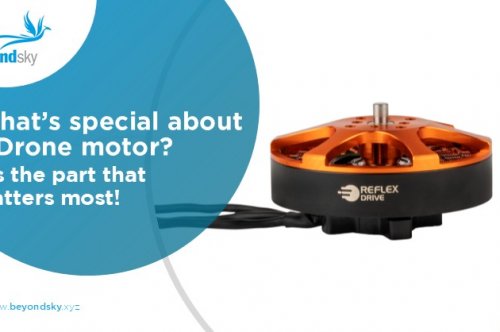
A good example is the Reflex Drive RD4006 motor, rated at 390 KV, which makes it great for balanced lift and smooth response in aerial or industrial drones.
You’ll often see something like “4S–6S” or “6S–8S.” That refers to how many LiPo battery cells are connected in series. Higher voltage means more potential power.
Continuous current is what a motor can safely handle for long flights. Peak power is the short-term boost during takeoff or acceleration. Always give yourself a little headroom so you’re not pushing the motor to its limit.
Motor weight affects your drone’s efficiency. Light motors mean longer flights, while heavier motors offer stability for larger payloads. Housing materials aluminum or carbon composite, also influence cooling and durability.
Overheating kills motors faster than almost anything else. Look for proper heat dissipation designs or waterproof ratings.
The T-MOTOR AX series, for example, uses a hollow front cover to pull air through, keeping it cool even during long fixed-wing missions.
Different drones demand different propulsion setups. Matching the motor to the task is half the battle in UAV design.
Every drone has a purpose and the motor should match that purpose. Using the wrong type can ruin efficiency, shorten flight time, or even cause instability mid-air.
Motors are durable but not invincible. A simple maintenance routine keeps them performing like new.
After each flight, check for dirt, sand, or grass caught around the shafts. Spin each motor by hands and it should feel smooth. If you hear grinding or resistance, bearings may need cleaning or replacement.
Dust and moisture are the enemies. Use compressed air or a soft brush to clean. If your motors aren’t waterproof, avoid flying in rain or mist.
Loose connections or damaged ESC wires can cause performance dips. Monitor current draw and heat during flight. If a motor runs hotter than the others, investigate before it fails mid-air.
Balance your propellers to minimize vibration. Replace motors that vibrate, overheat, or sound off. Store your drone in a dry space humidity corrodes connectors fast.
Drone propulsion is evolving quickly. Manufacturers are pushing for smarter, lighter, and more efficient designs.
The next generation of motors isn’t just about power it’s about intelligence and adaptability.
Here are a couple standout motors currently listed on BeyondSky, a drone marketplace for professional UAV components.
A lightweight brushless outrunner motor built for medium-lift UAVs. With a voltage range of 4S–6S and peak power output of 660W, it delivers reliable performance in aerial, industrial, and mapping applications. The IP34 waterproof rating adds field toughness for all-weather operation.
In use, this motor performs well in agricultural spraying drones, mapping platforms, and inspection UAVs that need steady thrust and reliable performance across variable loads.
This motor focuses on endurance and durability. It supports 6S–8S setups and includes a unique hollow front design for improved cooling. High-quality bearings and military-grade wiring help it withstand overload conditions, making it suitable for long-duration fixed-wing flights.
These are just two examples from a much larger lineup on BeyondSky. The platform curates drone motors and everything drones.
Drone motors might not be the flashiest part of a UAV, but they’re what make flight possible. The right motor brings balance, endurance, and performance together in a way that no software tweak can match.
As the drone industry moves toward higher efficiency and smarter integration, understanding how motors work and how to pick the right one becomes even more important. Whether you’re building, maintaining, or scaling fleets, a well-chosen motor is the quiet force behind every great flight.
The two primary types are brushed and brushless motors. Brushed motors use mechanical contact through carbon brushes and are mainly found in small hobby or toy drones. Brushless motors (BLDC) rely on electronic control for higher efficiency, power, and durability, making them standard in commercial, industrial, and racing UAVs.
Outrunner motors rotate their outer shell to deliver high torque at low RPM, ideal for multirotors and heavy-lift drones. Inrunner motors have an internal rotor that spins faster, generating high RPM with lower torque, making them suitable for racing and fixed-wing drones.
KV rating (RPM per volt) defines how fast a motor spins per volt of power. Low KV motors (300–900 KV) generate high torque for stable flight and payload lifting. High KV motors (1000–2500 KV) deliver greater speed for racing or acrobatic drones.
The thrust-to-weight ratio determines how efficiently a drone can lift and maneuver. A ratio of 2:1 is the industry norm, ensuring hover stability, smooth acceleration, and safe payload carrying capacity. Higher ratios improve agility, especially in racing or freestyle drones.
Low KV brushless motors with large stators are ideal for professional UAVs used in mapping, delivery, or agriculture. These motors provide steady power, high torque, and better efficiency to manage heavy payloads over longer flights.
Motor voltage ratings (often listed as 4S, 6S, or 8S) define speed and efficiency. Higher voltages mean more potential power. Propeller size must match the motor’s KV rating; large props pair with low KV motors for lift, while small props suit high KV motors for high-speed performance.
Emerging designs focus on lighter, more efficient motor housings, advanced winding patterns, built-in telemetry sensors for heat and RPM, and modular architecture for easier upgrades. New materials like carbon composites and titanium shafts are improving performance and durability across next-generation drone platforms.