

Drone Flight Controllers and Carrier Boards: The Core of UAV Intelligence
Published by:Beyond Sky
 English
When a drone lifts off, it looks simple from the outside. The motors spin, the propellers move air, and the machine rises. But the real work happens inside. The flight controller and carrier board decide how every part moves, stays balanced, and reacts to the world.
These two components turn a frame with motors into an aircraft that can think and respond. They’re not visible, but they make every flight possible.
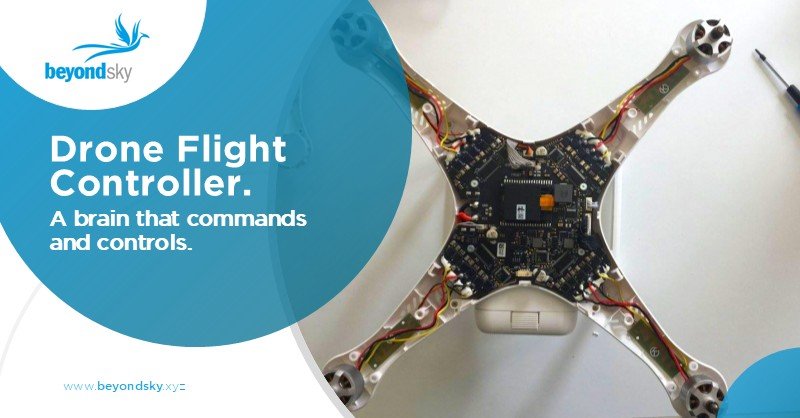
A flight controller (FC) is the onboard computer that stabilizes a drone and manages its movement. It receives thousands of data points per second from sensors and translates them into commands that keep the aircraft balanced, responding to pilot input, or executing autonomous missions.
In simple terms, the flight controller acts as the brain of the drone. It handles:
In industrial UAVs, the flight controller is responsible not only for flight stability but also for ensuring the aircraft meets regulatory standards for redundancy, safety, and failover capability, especially during BVLOS missions.
Professional flight controllers incorporate a range of precision sensors and processors. Each plays an essential role in real-time stabilization.
The IMU is at the core of every FC. It combines:
These sensors allow the flight controller to constantly track the drone’s orientation and react in milliseconds to stabilize it.
Supports GPS, GLONASS, Galileo, BeiDou, and in advanced drones, RTK/PPK systems for centimeter-level accuracy.
GNSS signals are used for:
Used to maintain stable height, especially during takeoff, landing, and indoor or low-GNSS environments.
Executes flight algorithms, PID loops, navigation calculations, and sensor fusion in real time.
Professional FCs use powerful processors to support:
Ensures the flight controller receives clean and stable voltage. It also monitors battery health, current draw, and failsafe conditions.
Flight controllers include multiple communication standards such as:
These ports allow integrators to connect sensors, companion computers, cameras, payload controllers, and telemetry modules.
A carrier board is the hardware interface that connects the flight controller to the rest of the drone’s systems. It expands the capabilities of the FC by providing structured power distribution, sensor connectivity, payload interfaces, and additional computing resources.
Think of the flight controller as the “CPU” and the carrier board as the “motherboard.”
In professional UAV design, the carrier board determines:
Carrier boards are essential in customized or industrial drones where off-the-shelf FCs do not provide enough I/O flexibility.
A flight controller alone cannot support all functions needed in commercial or enterprise UAVs. That’s where carrier boards come in. They enable:
Carrier boards unlock the full potential of the flight controller and make the drone scalable for future upgrades.
The flight controller and carrier board work as a single system.
Sensors like gyroscopes, accelerometers, and magnetometers send live data to the controller. The carrier board links those sensors to the processor. Based on that input, the controller adjusts each motor through the ESCs to keep the drone balanced.
This happens hundreds of times per second. It’s a constant cycle of input and correction that allows the drone to hover, climb, or turn smoothly. Without it, flight would collapse into chaos.
Every flight controller depends on a few essential sensors. They act as the drone’s perception system:
Together these sensors form the IMU (Inertial Measurement Unit). It provides the raw data that keeps a drone aware of its position and motion.
Different goals need different kinds of controllers.
A basic controller with good stabilization and simple setup is enough. It handles short flights and learning tasks without complexity.
Controllers that support multiple sensors, high-precision GPS, and advanced flight logs are standard. Many builders use Pixhawk or CubePilot systems for industrial mapping and survey work.
Controllers with low latency and high refresh rates matter most. They translate input into movement without delay, giving the pilot more control.
Before buying, check for firmware updates, build documentation, and available parts. A good ecosystem saves effort during maintenance or upgrades.
Most drones use one of three main setups:
Professional UAVs often include backup power and duplicate communication paths to protect against single-point failure.
A strong flight controller and carrier board give you:
For commercial operators, that translates to better mission data and lower maintenance risk.
BeyondSky is the world’s first global B2B marketplace dedicated to drones and UAV technology. The platform connects buyers with:
Engineers, integrators, and operators can explore options, compare specifications, and source components directly from trusted suppliers without middlemen.
In conclusion, the flight controller and carrier board don’t draw attention, but they define the drone’s capability. They process movement, balance, and communication in one closed loop.


